
Rewind or replace an electric motor? How to make the right decision
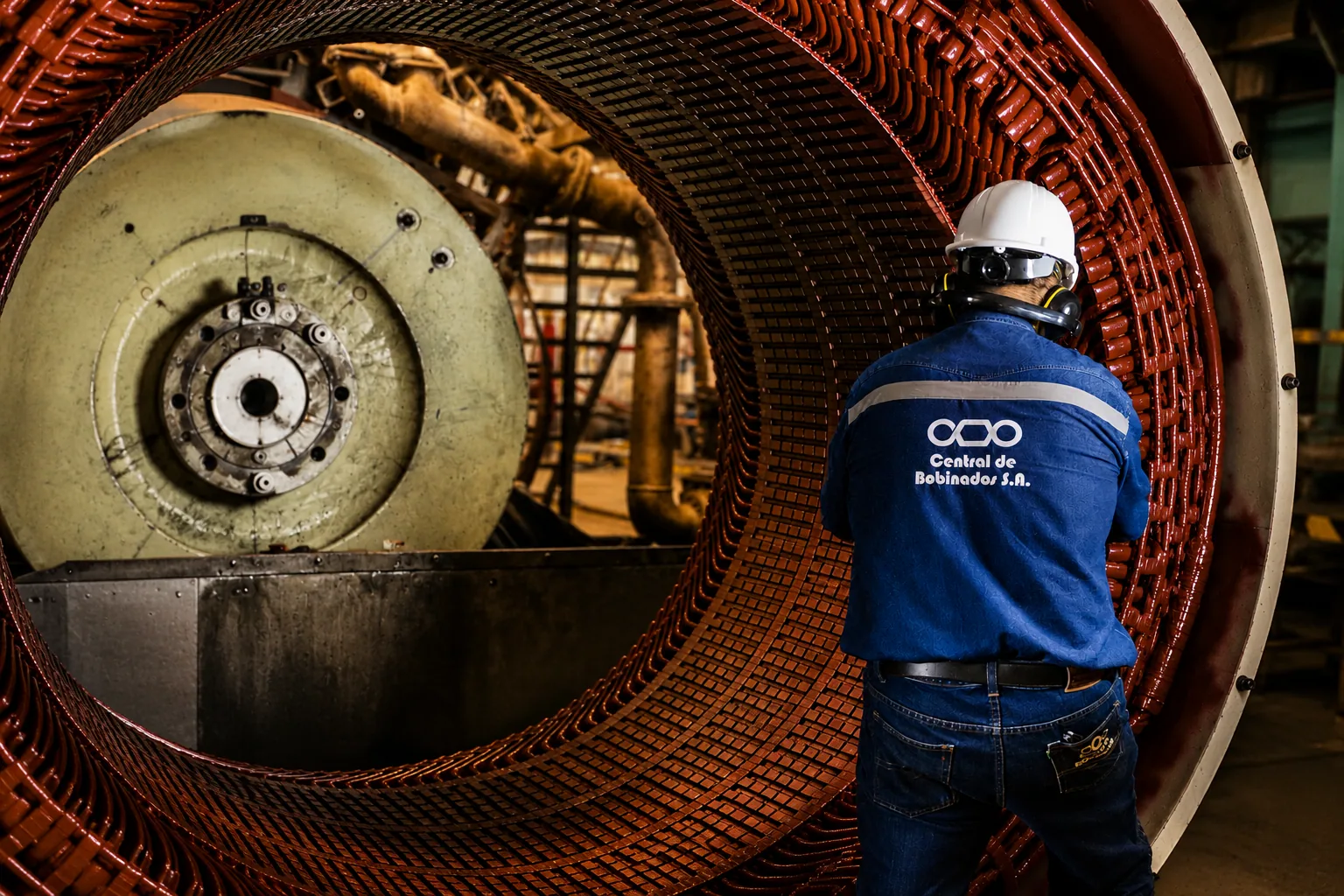
When an industrial electric motor fails, the maintenance team always asks the same question: do we rewind it or buy a new one? In most industrial cases —especially medium- and high-voltage motors, or large, special machines— rewinding is more cost-effective and faster than replacing, because an equivalent new motor can mean weeks or months of lead time and a much higher cost. But it is not an absolute rule: the right decision depends on the condition of the magnetic core, the failure history, the criticality of the equipment, and a technical diagnosis that determines whether rewinding is viable. With more than 80 years repairing rotating machinery, these are the criteria we use to decide with data, not intuition.
What does "rewinding" a motor mean?
Rewinding means removing the damaged winding from a motor or generator, manufacturing and installing a new one, and restoring the insulation system, returning the machine to its original specification. It is not a patch: it rebuilds the electrical heart of the machine. The key is to preserve the properties of the core (lamination stack) and the quality of the new insulation.
When to REWIND
- The core is in good condition. It is the most expensive and hardest part to replace; if it is healthy, rewinding is almost always the smart choice.
- It is a medium- or high-voltage motor, large or of special design, where a new replacement is expensive and has a long lead time.
- The equipment is critical and you need it back in operation fast to avoid plant downtime.
- The failure is in the winding or insulation, not in irreparable structural damage.
When to REPLACE
- The core is damaged by severe overheating (shorted laminations) and efficiency cannot be recovered.
- It is a small, standard low-voltage motor, where a new one costs almost the same and is available immediately.
- The motor is obsolete and a higher-efficiency model exists that pays for itself in energy consumption.
The cost rule
As a general industry guideline, when the repair cost exceeds ~60% of the value of an equivalent new motor (some sources use a range of 50-75%), replacement is worth evaluating. Below that threshold —the case for most medium and large motors— rewinding is the economically correct decision.[1] But price is not everything: the lead time of a new medium/high-voltage motor often tips the balance toward rewinding.
Does a rewound motor lose efficiency? What the evidence says
Here is a myth worth clearing up with data. The independent studies by EASA and AEMT —including the one on premium IE3 motors— show that a rewind using good practices maintains the motor's original efficiency within ±0.2%, and that performing several rewinds does not degrade efficiency cumulatively.[2] In other words: done right, the motor stays as efficient as before.
The difference is in "done right". In every rewind we apply:
- Before-and-after diagnosis with electrical tests (IR/PI insulation resistance, HIPOT, Tan Delta, partial discharge and core analysis). See Technology →
- VPI-impregnated insulation (vacuum pressure impregnation), which seals the winding into a solid mass with no air voids —the silent origin of thermal failure.
- Dynamic rotor balancing per ISO 21940-11 to eliminate vibrations that shorten bearing life.[3]
- EASA AR100 accreditation: an international standard (ANSI/EASA AR100), third-party audited, that certifies the good repair practices which preserve a motor's efficiency and reliability.[4] See Certifications →
Frequently asked questions
Does a rewound motor lose efficiency?
No, if it is done with good practices. EASA/AEMT studies confirm efficiency is maintained within ±0.2%. A poor repair can degrade it; that is why who does it matters.
How long does a rewind take?
It depends on the size and voltage of the motor. For critical equipment we offer on-site service and 24/7 emergency support to minimize plant downtime.
Up to what voltage do you rewind?
We work on low-, medium- and high-voltage rotating machinery, including the manufacture of preformed coils for medium and high voltage.
Can I find out whether rewinding is worth it before deciding?
Yes. A diagnosis determines the condition of the core and insulation, and with that we give you an honest recommendation —even if that recommendation is to replace.